
Side drives, two-car drives and aprons
Concrete Driveways in Parma, OH
A new driveway built from the gravel up, sloped to drain and mixed to handle salt and snow.
- Free on-site estimates with measurements and a base check
- Written, itemized quote before any demolition starts
- Air-entrained concrete, cut joints and a full cure on every pour
Replacing the Driveway Your House Came With
Concrete driveways in Parma take more punishment than almost any other concrete on the property. They carry cars every day, catch snowplow piles and road salt, and on some older lots they run the full depth of the yard to a garage in back. When a driveway is cracked into slabs that rock underfoot, holds puddles that freeze into ice sheets, or flakes across the whole surface, a new one is usually the answer.
Why so many Parma driveways fail the same way
About 39% of Parma homes were built in the 1950s, according to Point2Homes' summary of Census survey data, and the median build year is 1958. An original driveway from that era may be thinner than today's standard or sit on little or no gravel. Over the decades water gets under a slab like that, freezes, and lifts and drops it. The result is the familiar pattern: cracks across the width, sunken sections near the garage, and a raised lip where the drive meets the walk.
A new slab on the same base fails the same way. That is why every driveway we replace starts with digging out to firm soil and building a new base of compacted crushed stone.
Signs it is time to replace
- Cracks wide enough to catch a shoe or a snow shovel
- Sections that have sunk or tipped toward the house or garage
- Scaling or flaking across most of the surface, not just one spot
- Water pooling on the drive or running toward the foundation
- Patches and overlays that keep coming loose
- A drive too narrow for the cars you own now
What a good Ohio driveway needs
The parts that make a driveway last are mostly underground or invisible once it is poured. The base needs to be compacted in lifts. The concrete needs to be air-entrained so freezing water has room to expand. Thickness should match the load: HomeGuide notes 4 inches is standard for cars and recommends 5 to 6 inches for RVs or heavy traffic, with thicker edges. Control joints need to be cut at the right spacing and early enough to control where the slab cracks. The surface needs a broom finish for grip in snow, a proper cure, and a sealer before the first winter.
Long side drives and detached garages
When a driveway runs along the house to a garage in back, the layout leaves little room for equipment, so we plan access carefully, protect the lawn and neighboring drive, and stage the pour so the truck reaches every section. Where the drive meets the garage floor we match heights so water stays outside. If the garage slab is failing too, replacing both at once keeps the two surfaces level with each other.
Widening and adding a pad
Many original drives were sized for one car. Widening a drive or adding a parking pad beside it is common. New concrete is tied to the old with dowels or poured as a separate slab with a joint, depending on the condition of the existing drive. If the old slab is near the end of its life, replacing it at the same time usually costs less than widening now and replacing later.
Caring for a new driveway
Stay off it on foot for about a day and with cars for about a week, longer in cool weather. Skip deicing salt through the first winter and use sand for traction. Reseal every few years. Shovel or plow with a blade that will not gouge the surface, and keep downspouts aimed away from the slab edges so water does not undermine them.
Parts of a Driveway Job
Each driveway quote is broken into these pieces so you can see where the money goes.
Break-out and disposal
The old concrete is broken up, loaded and hauled away, along with any asphalt patches or failed overlays.
Excavation and new stone base
We dig to firm soil, set crushed stone in lifts and compact each one so the slab has even support.
Steel and thickness
Rebar or wire mesh where it helps, with thicker sections at edges, the apron and anywhere heavy vehicles park.
Air-entrained pour and broom finish
Concrete mixed for freeze-thaw, finished with a broom texture for traction in snow and rain.
Joints, cure and seal
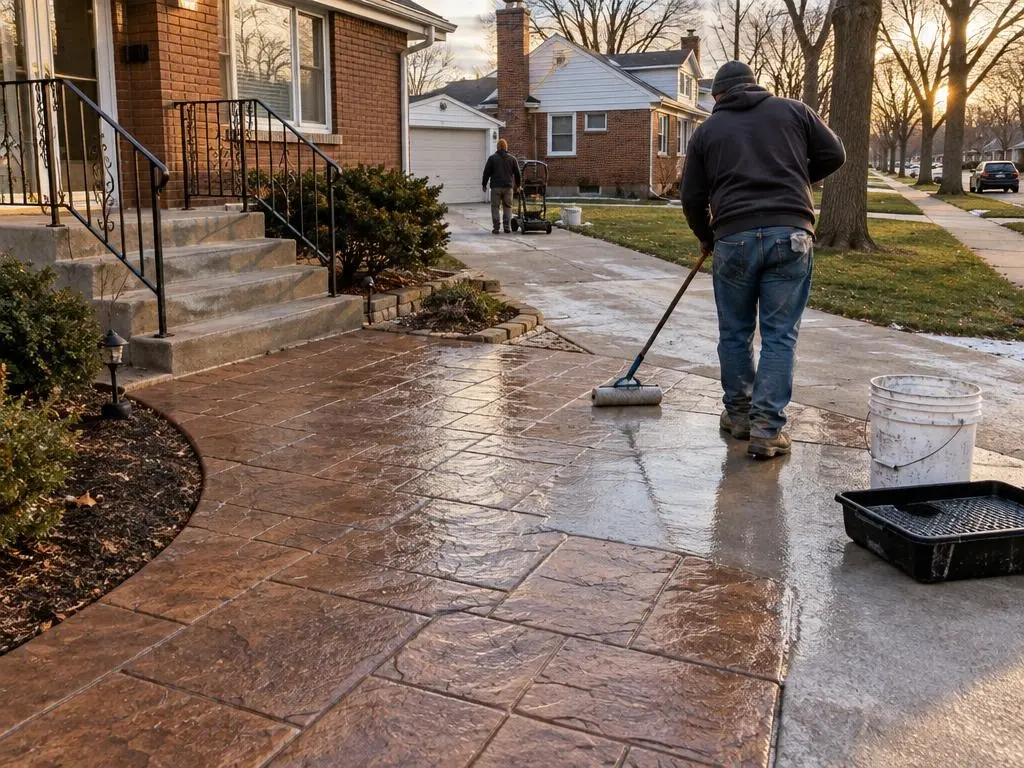
Control joints cut on time, a curing period before traffic and a penetrating sealer before the first winter.
Apron at the street
The section between the sidewalk and the road, poured to whatever the city requires for your street.
Typical Concrete Driveway Costs
| Item | Published range |
|---|---|
| Plain concrete, per sq ft installed | $6 to $10 |
| One-car drive, 12 x 24 ft | $1,700 to $4,300 |
| Two-car drive, 20 x 20 ft | $2,400 to $6,000 |
| Two-car drive, 24 x 24 ft | $3,500 to $8,600 |
| Old driveway removal, per sq ft | $2 to $6 |
| Rebar reinforcement, per sq ft | $1 to $3 |
| Sealing, per sq ft | $1 to $3 |
National ranges from HomeGuide's concrete driveway cost guide. Parma driveways are often long and narrow, and base repair, thickness and access all change the total. Your written estimate is the price.
How a Driveway Replacement Goes
1. Measure and plan
We measure the drive, check slope and drainage, and confirm width, thickness and finish with you.
2. Remove and rebuild the base
The old slab comes out and a new compacted stone base goes in, usually in one day.
3. Form and pour
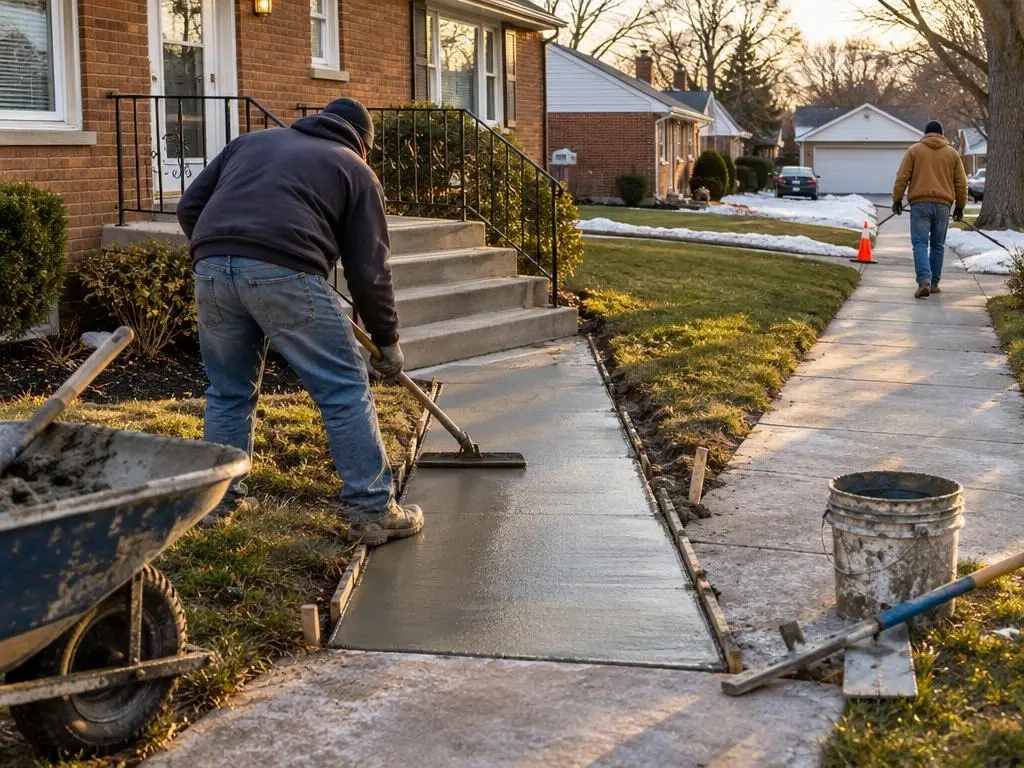
Forms are set to slope, steel is placed and the concrete is poured, finished and jointed.
4. Cure and hand back
We seal the slab and give you dates for walking, parking and using salt.
Concrete Driveways Questions
How long does a concrete driveway last?
HomeGuide puts concrete driveway life at about 30 to 40 years with maintenance. In Northeast Ohio, the base, air entrainment and sealing decide where in that range a driveway ends up.
Should I replace my driveway with concrete or asphalt?
HomeGuide lists asphalt at about $5 to $12 a square foot with a 15 to 30 year life, against $6 to $15 and 30 to 40 years for concrete. Asphalt is cheaper up front and handles salt well. Concrete lasts longer, stays cooler and needs less frequent upkeep.
How thick should my driveway be?
Four inches is standard for passenger cars. We go to 5 or 6 inches where trucks, campers or trailers park, and thicken the edges and apron.
Can you replace just part of my driveway?
Yes, if the rest is sound. We cut out the failed sections at existing joints and pour new ones level with the old. If most of the drive is failing, full replacement usually costs less over time.
How soon can I park on a new driveway?
Usually about a week for cars, longer in cool weather. We give you a specific date based on the pour conditions.
Concrete Driveways Service Areas
- Concrete Contractors in Parma, OH
- Concrete Contractors in Parma Heights, OH
- Concrete Contractors in Seven Hills, OH
- Concrete Contractors in North Royalton, OH
- Concrete Contractors in Brooklyn, OH
- Concrete Contractors in Middleburg Heights, OH
- Concrete Contractors in Strongsville, OH
- Concrete Contractors in Broadview Heights, OH
- Concrete Contractors in Brook Park, OH
- Concrete Contractors in Berea, OH
- Concrete Contractors in Independence, OH
- Concrete Contractors in Brecksville, OH
- Concrete Contractors in Old Brooklyn, OH
- Concrete Contractors in Garfield Heights, OH
- Concrete Contractors in Maple Heights, OH
- Concrete Contractors in North Olmsted, OH
- Concrete Contractors in Fairview Park, OH
- Concrete Contractors in Lakewood, OH
- Concrete Contractors in Rocky River, OH
- Concrete Contractors in Westlake, OH
- Concrete Contractors in Olmsted Falls, OH
- Concrete Contractors in Hinckley Township, OH
- Concrete Contractors in Brooklyn Heights, OH
- Concrete Contractors in Valley View, OH
Get a Concrete Driveways Estimate
Free on-site estimates for concrete driveway replacement in Parma and nearby suburbs.